🌐 06-03: DNS Packets Construction
📌 Introduction
DNS packets are the core units of communication in the Domain Name System. They carry queries (requests) and responses (answers) between clients and DNS servers.
🧱 DNS Packet Structure
A DNS packet follows a layered structure:
IP Header → UDP Header → DNS Header → DNS Data
- IP Header → handles routing
- UDP Header → uses port 53
- DNS Header → controls behavior
- DNS Data → contains actual query/response
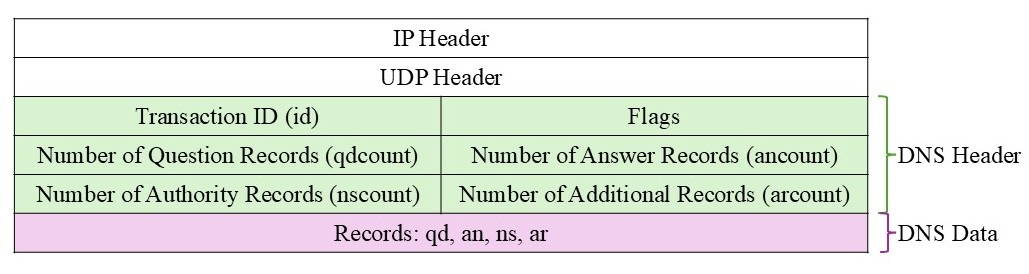
🧩 DNS Header Fields
| Field | Purpose |
|---|---|
| id | Unique transaction ID |
| flags | Query/response control |
| qdcount | Number of Question Records |
| ancount | Number of Answer Records |
| nscount | Number of Authority Records |
| arcount | Number of Additional Records |
⚙️ Important Flags
- qr → 0 = query, 1 = response
- aa → authoritative answer
- rd → recursion desired
- ra → recursion available
📦 DNS Data Field
| Section | Description |
|---|---|
| qd | Question (what we ask) |
| an | Answer (final IP) |
| ns | Authority (who knows) |
| ar | Additional (extra helpful info) |
📄 DNS Records (Concept)
Query: www.example.com
Response breakdown: - Question → what we asked - Answer → IP of domain - Authority → which server is responsible - Additional → IP of that server
🛠️ DNS Structure in Scapy
Command: ls(DNS)
This shows all DNS fields: - qd → question - an → answer - ns → authority - ar → additional
🧪 DNS Query Record (DNSQR)
DNSQR = Question part of DNS packet
Fields: - qname → domain name - qtype → record type (A = IPv4) - qclass → class (IN = Internet)
🧪 DNS Resource Record (DNSRR)
DNSRR = Actual data in response
Used in: - Answer - Authority - Additional
Fields: - rrname → domain name - type → record type - rclass → class - ttl → cache duration - rdata → actual value (IP / NS)
📡 Example: Sending a DNS Query
Code:
#!/usr/bin/env python3
from scapy.all import *

IPpkt  = IP(dst='8.8.8.8')        # DNS server
UDPpkt = UDP(dport=53)            # DNS port

Qdsec  = DNSQR(qname='www.example.com')

DNSpkt = DNS(
    id=100,
    qr=0,
    qdcount=1,
    qd=Qdsec
)

packet = IPpkt / UDPpkt / DNSpkt

response = sr1(packet, timeout=2)

if response:
    print(response[DNS].summary())
Explanation: - IP → where to send - UDP → DNS port - DNSQR → question - DNS → full packet - "/" → combines layers - sr1() → send + wait for reply
🖥️ Simple DNS Server
Step 1: Receive Query
Code:
#!/usr/bin/env python3
from scapy.all import *
from socket import socket, AF_INET, SOCK_DGRAM

sock = socket(AF_INET, SOCK_DGRAM)
sock.bind(("0.0.0.0", 1053))

while True:
    data, addr = sock.recvfrom(4096)

    dns_req = DNS(data)
    query_name = dns_req.qd.qname.decode()

    print("Query:", query_name)
Explanation: - Opens UDP server - Receives DNS packet - Extracts domain name
Step 2: Build Response
Code:
answer = DNSRR(
    rrname=dns_req.qd.qname,
    type="A",
    rdata="10.2.3.6",
    ttl=300
)
Explanation: - Creates answer record - Maps domain → IP
Step 3: Send Response
Code:
dns_resp = DNS(
    id=dns_req.id,
    qr=1,
    aa=1,
    qd=dns_req.qd,
    qdcount=1,
    ancount=1,
    an=answer
)

sock.sendto(bytes(dns_resp), addr)
Explanation: - id must match - qr=1 → response - aa=1 → authoritative - attaches answer
🧪 Advanced DNS Response (Answer + Authority + Additional)
from scapy.all import * from socket import socket, AF_INET, SOCK_DGRAM
Create UDP socket (DNS server)
sock = socket(AF_INET, SOCK_DGRAM) sock.bind(("0.0.0.0", 1053)) # Port 1053 (non-root DNS port)
while True: data, addr = sock.recvfrom(4096)
# Parse incoming DNS request
DNSreq = DNS(data)
query_name = DNSreq.qd.qname.decode()
print("Query:", query_name)

# -------------------------------
# 🟢 Answer Section (Final IP)
# -------------------------------
Anssec = DNSRR(
    rrname=DNSreq.qd.qname,
    type='A',
    rdata='10.2.3.6',
    ttl=259200
)

# -------------------------------
# 🟡 Authority Section (Name Servers)
# -------------------------------
NSsec1 = DNSRR(
    rrname="example.com",
    type='NS',
    rdata='ns1.example.com',
    ttl=259200
)

NSsec2 = DNSRR(
    rrname="example.com",
    type='NS',
    rdata='ns2.example.com',
    ttl=259200
)

# -------------------------------
# 🔵 Additional Section (IP of NS)
# -------------------------------
Addsec1 = DNSRR(
    rrname='ns1.example.com',
    type='A',
    rdata='10.2.3.1',
    ttl=259200
)

Addsec2 = DNSRR(
    rrname='ns2.example.com',
    type='A',
    rdata='10.2.3.2',
    ttl=259200
)

# -------------------------------
# 🔴 Build Full DNS Response
# -------------------------------
DNSpkt = DNS(
    id=DNSreq.id,      # Match request ID
    qr=1,              # Response
    aa=1,              # Authoritative Answer
    rd=0,              # Recursion not supported

    qdcount=1,
    ancount=1,
    nscount=2,
    arcount=2,

    qd=DNSreq.qd,      # Original question
    an=Anssec,         # Answer section
    ns=NSsec1 / NSsec2,  # Authority section
    ar=Addsec1 / Addsec2 # Additional section
)

# Debug print
print(repr(DNSpkt))

# Send response back to client
sock.sendto(bytes(DNSpkt), addr)
🔄 Communication Flow
Client → DNS Query → Server Server → DNS Response → Client
🧠 Key Takeaways
- DNS = layered protocol
- DNSQR → query
- DNSRR → answer
- Header controls everything
- Scapy allows custom packets
🚀 Why This Matters
- Debugging networks
- Packet analysis
- Security research
- Building DNS systems
✅ Final Flow
IP → UDP → DNS Header → Question → Answer → Authority → Additional